
Why Spain's World Cup Win Is Barcelona's Reason to Believe?
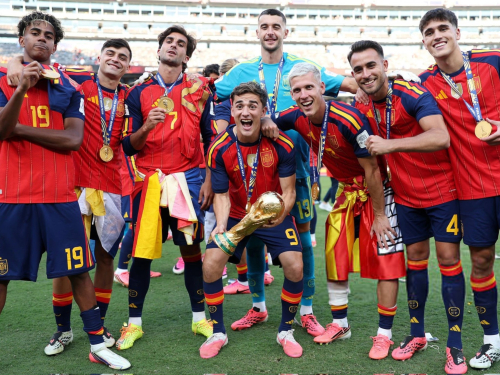
Between the start of their title defence in 2014 and the beginning of their new conquest in 2026, Spain played and lost just two World Cup knockout matches, as they desperately struggled to rekindle the glowing form of their golden generation that won three consecutive major titles.
However, on Sunday in New Jersey, the years of building a new generation finally paid off, as Ferran Torres' extra-time strike beat Argentina 1-0 and handed La Roja their second World Cup in a match that'll go down as one of the most one-sided World Cup finals.
And just like the Spanish national team, Barcelona have had their hearts broken again and again in their hunt for a sixth Champions League trophy, a wait that has now stretched past a decade since 2015.
The push to match their treble-winning standards has turned into growing frustration. From the final years of Lionel Messi in Camp Nou to the start of Lamine Yamal's story, Europe has simply not been kind to the club.
But Barcelona, under president Joan Laporta, are building something astonishing. And just like Spain, who found the light at the end of the tunnel, their own moment may be closer than it looks — and largely in their own hands.
Spain's Conquest Renews Hope at Barcelona
Spain didn't win the World Cup by accident; their conquest was the product of a process built over years, from Luis Enrique's tenure to Luis de la Fuente's, blooding young players in competitive tournaments long before the pressure of a final.
It is exactly that same patient approach that Barcelona are trying to replicate, and the overlap between the two projects is not a coincidence. But while the club has enjoyed good fortunes domestically, the continental prize continues to elude them.
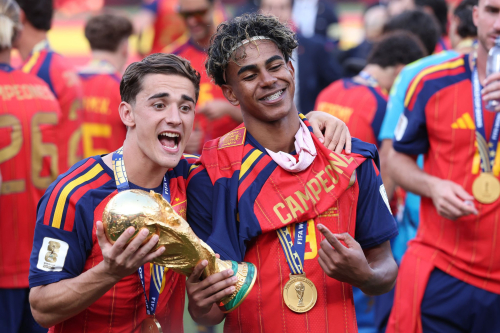
Eight Barcelona players were part of Spain's 26-man World Cup squad. Joan García, Eric García, Pau Cubarsí, Gavi, Pedri, Dani Olmo, Ferran Torres and Lamine Yamal, with at least three in every starting XI named at the tournament.
That is by some distance the largest single-club representation in the group, more than any Real Madrid contribution — in fact, for the first time in the tournament's history, no Real Madrid player made Spain's final list at all.
Ferran Torres, introduced as a second-half substitute, scored the winning goal in the final. Pau Cubarsi, still a teenager, played every minute of Spain's run to the trophy, starting alongside Aymeric Laporte in the heart of defence and ultimately winning the Young Player of the Tournament.
Lamine Yamal, another teenager, also contributed his part on the right flank, while the duo of Pedri and Dani Olmo shone in midfield. There was no appearance for Joan Garcia, but the talented Goalkeeper can wait for his time as he is the future, after Unai Simón.
This is the case for Barcelona fans holding onto hope. The set of players expected to carry their Champions League ambitions has just been tested on the biggest stage football offers, and they did not buckle.
Tournament football teaches composure, game management and how to close matches out under pressure, precisely the traits that have been missing when Barcelona have needed them most in Europe.
Past Stumbling Blocks
Barcelona's recent Champions League exits have not come down to a lack of quality, but down to small, avoidable errors at moments that decide ties, and Hansi Flick will hope the World Cup experience helps solve this in the future.
In their elimination loss to Inter, Barcelona had the chance to protect their advantage and see out a result that could have sent them through to the final, but inexperience cost them, and their opponent didn't just level but went on to win.
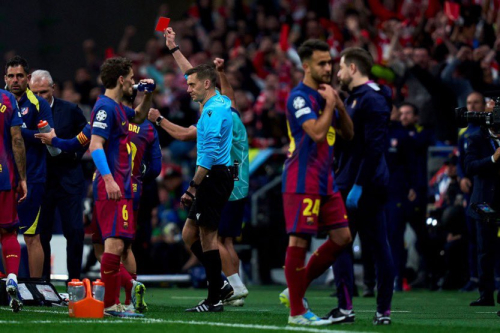
A year later, in April 2026, Barcelona's Champions League campaign was undone again, this time in the quarter-finals against Atlético Madrid, with Pau Cubarsi sent off for a last-man foul on Giuliano Simeone, with Argentine striker Julian Alvarez scoring from the resulting free-kick.
Needing just one goal to even the tie at 3-3 after losing 2-0 at home in the first leg, Eric Garcia picked up an unnecessary red card that reduced them to 10 men, and allowed Atlético Madrid to see out a narrow aggregate win.
Two different rounds, two different opponents, but the same underlying story of young players making costly errors that experienced sides do not often make. However, these young players have taken Spain to the climax of the game, and will henceforth no longer qualify as inexperienced.
The Future Overcoming Its Growing Pains
This is where Spain's World Cup win matters for Barcelona beyond simple club pride. Cubarsí, Pedri, Yamal, and others have now played World Cup knockout football, including a final decided in extra time against an Argentina side unwilling to give an inch.
Cubarsí was directly involved in winning the free-kick that led to Argentina finishing with ten men, whereas that is the kind of composure under duress that was missing against Atlético a few months earlier.
Pedri, Olmo and Fermín López (who missed the World Cup itself through injury but trained through the buildup) have also had a season of high-stakes football, domestically and for the national team, to sharpen their decision-making.
Ferran Torres scoring the World Cup final winner as a substitute shows a maturity in big moments that he will hope translates directly into club football, although his chapter at Barcelona could come to a halt this summer.
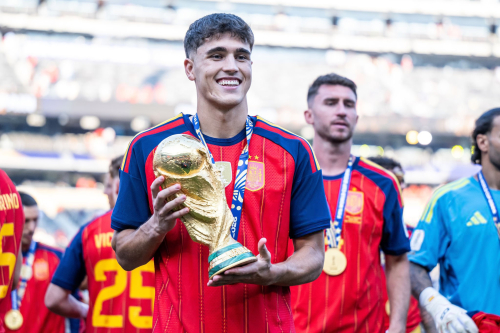
Nevertheless, none of this guarantees Barcelona will win the Champions League, but looking at the pattern Spain has shown with years of patient investment in youth eventually turning into a glorious World Cup tournament, Laporta's Barcelona could be set to repeat it.
Joan Laporta's Long Game is Getting Closer
Joan Laporta's presidency has been defined by financial strain but also by a refusal to abandon the club's academy pipeline even in the toughest years.
Pau Cubarsí, Lamine Yamal, Pablo Gavi, Alejandro Balde and Fermín López all came through La Masia and were handed first-team opportunities before coming of age, decisions that have already delivered multiple domestic successes and helped re-establish their dominance.
Adding more to their joy is Spain's World Cup win, which is proof that this kind of patience eventually pays off on the biggest stages, and their own young crop being at the heart of such a remarkable outing makes it more reassuring.
The days of Barcelona's Champions League drought, which has now lasted over a decade, may be coming to an end sooner rather than later. This looks like a matter of time rather than it is a wishful thinking.
