
Where did Socceroos Came from? How Australia NT got their nickname

The Socceroos put Australia on the lips of football enthusiasts during the 2026 FIFA World Cup following their involvement in the first-ever knockout match to feature no UEFA, CONMEBOL, or CONCACAF teams, in the round of 32 penalty shootout loss to Egypt.
It was their first-ever back-to-back appearance in the knockout stage of the tournament, after famously progressing from Group D in 2022 by beating Denmark and Tunisia, a testament to how far football in the country has come in recent years.
When you think about Australian sports, icons like the boxing kangaroo, the baggy green cricket cap, or the intense oval-ball battles of Aussie Rules football easily come to mind. But over the last few decades, a major footballing revolution has taken over the land Down Under.
At the center of this movement is the men's national football team, widely known and loved globally as the Socceroos.
But where exactly did this unique name come from?
Where Did Socceroos Come From?
For the first few decades of their existence, the Australian national team did not have a proper identity. In the local newspapers, journalists lazily called them the internationals, the squares, or simply the Australian soccer team.
It lacked the flavor and patriotic punch needed to rally fans behind a national cause. But who can blame the fans when the country only appeared at the FIFA World Cup tournament once until 2022?
But in 1967, everything changed.
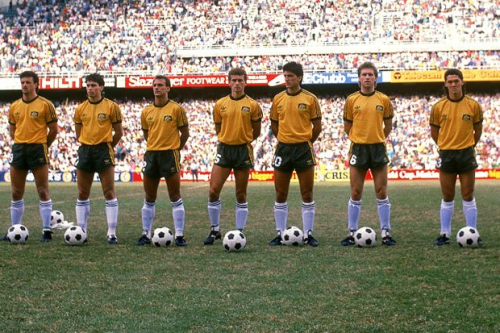
A prominent Sydney sports journalist named Tony Horstead, writing under the clever pen name Inswinger for The Daily Mirror, wanted to give the team a catchy nickname during a tour of Asia at the height of the Vietnam War.
Horstead combined two words that defined the team’s purpose and home: soccer, as in the name of the sport, and Kangaroo, which was already heavily associated with the country's sporting identity (like the rugby league Kangaroos or the cricket team's baggy green cap featuring the coat of arms).
Initially, it was just a catchy headline, although it perfectly mirrored other iconic Australian sports teams. It wasn't until the 1970s that it was officially adopted as a trademark by the Australian Soccer Federation ahead of their historic 1974 FIFA World Cup campaign.
Early Footballing History of Socceroos
Football in Australia actually goes back to the late 19th century, driven largely by British immigrants. The national team played its first official international matches in 1922, during a three-match tour against neighbors New Zealand.
For a very long time, Australia operated under the Oceania Football Confederation (OFC). While they completely dominated small island nations, the path to the World Cup was a logistical nightmare.
At the time, FIFA gave Oceania only half a qualifying slot, meaning the top team in the region always had to compete in a tough intercontinental playoff against heavyweights from South America or Asia just to qualify.
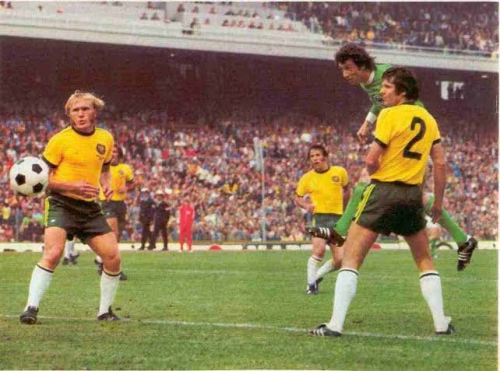
Despite these hurdles, the 1974 squad, consisting entirely of part-time, amateur players including miners, milkmen, and laborers, defied the odds and secured a historic ticket to the tournament held in West Germany.
Led by coach Rale Rasic, the Socceroos defeated South Korea in a tense playoff in Hong Kong to reach the finals, where they secured their first-ever tournament point in a 0-0 draw against Chile, although they finished bottom of the group following losses to West and East Germany.
The Moment That Changed Everything
Following their 1974 debut, a massive 32-year World Cup drought followed, and heartbreak became a regular routine for Australian football fans, who watched Socceroos miss out on seven consecutive global showpieces.
The most agonizing moment came in 1997 when they blew a 2-0 lead against Iran at the Melbourne Cricket Ground, missing out on the 1998 World Cup on away goals.
To break this curse, Australian football underwent two massive structural changes: first migrating from Oceania to Asia, and developing their golden generation of 2006.
The Great Migration to Asia in 2006
Realizing that playing uncompetitive matches in Oceania was halting their growth, Australia made a bold political move in January 2006, when they officially left the OFC and joined the Asian Football Confederation (AFC).
This guaranteed them regular, high-level competitive matches against top Asian sides like Japan, South Korea, and Saudi Arabia, who are also building a dynasty to compete at the highest level, and it completely transformed their tactical development.
The Golden Generation and the 2006 Breakthrough
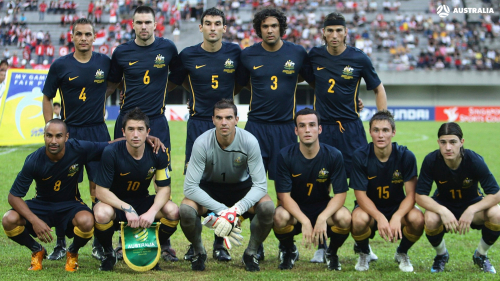
Under the tactical guidance of Dutch mastermind Guus Hiddink, Australia finally broke the qualification curse in November 2005 by shocking a South American team in the intercontinental playoffs.
In a dramatic penalty shootout against Uruguay in Sydney, which marked their final match under the flag of OFC, goalkeeper John Aloisi scored the winning penalty to book their ticket to Germany 2006, ending a 32-year World Cup wait.
Their squad of that year included famous stars like Tim Cahill of Everton, Liverpool's Harry Kewell, powerful Middlesbrough striker Mark Viduka, and club teammate, goalkeeper Mark Schwarzer.
Socceroos' Major Achievements
Since breaking that 32-year jinx, the Socceroos have established themselves as an unbroken fixture at the global finals, qualifying for every single edition since and reaching the knockout stage on three occasions.
They were four-time Oceanian champions before the migration, thanks to their conquests in 1980, 1996, 2000, and 2004, while they have also added one AFC Cup by beating South Korea in the 2015 final.

This made them hold a unique footballing achievement as the only men's national team in history to win continental championships in two different confederations (OFC and AFC).
However, their biggest footballing achievement came in 1997, when they finished runner-up in the FIFA Confederation Cup, where they defeated Mexico and the Czech Republic before losing to Brazil in the final.
The Legacy of Tim Cahill and Modern Resurgence
You cannot learn about the Socceroos without getting to know the impact of Tim Cahill, who is widely considered the undisputedly the greatest icon of Australian football.
The Everton legend scored Australia’s first-ever World Cup goal during a legendary 3-1 comeback win against Japan in 2006, and finished as their all-time top scorer with 50 goals in 108 caps, joining an elite club of global players who scored in three consecutive World Cups.

Today, a new generation of players is carrying the torch, mixing gritty defensive resilience with tactical discipline. Socceroos now rely heavily on a solid structure rather than relying on a single superstar.
Conclusion
The story of the Socceroos is a masterclass in identity and ambition. What started as a quirky word cooked up by a creative journalist in 1967 has transformed into a globally recognized brand that represents fighting spirit and sportsmanship.
From the agonizing heartbreaks of the Oceania days to lifting continental silverware in Asia and battling hard on the world stage, the Socceroos continue to show that they can compete with the absolute best in the beautiful game, and with their recent improvements, they are closing the gap in tournaments in and out.
