
How Infantino monetized loyalty to make the 2027 election a mere formality
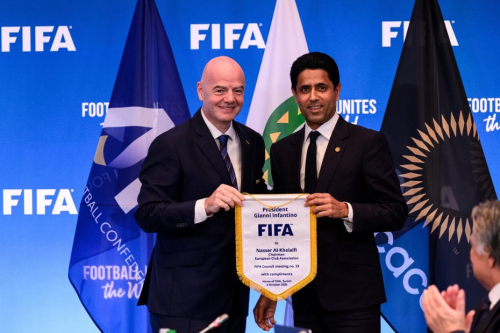
At the 76th FIFA Congress in Vancouver, Gianni Infantino told the 211 member associations he would be a candidate for the FIFA presidency in the 2027 election, where a victory would see him rule for a forth term.
Even though it is normal for a seated President to seek re-election, the Swiss has made the headlines for several wrong reasons, yet what everyone present could do was applaud, and no one, at the time challenged him.
FIFA Elections: One Country, One Vote
FIFA's electoral math is deceptively simple as it gives each member federation gets exactly one vote, regardless of size. Although the organization looks like a federation, it operates like a parliament.
The six confederations, AFC, CAF, CONCACAF, CONMEBOL, OFC, and UEFA, control the votes, the 211 member associations cast them, and a president converts political alignment into commercial outcome.
That means Aruba, a Caribbean island with barely 100,000 people, carries the same electoral weight as England, Germany, or Brazil.
This structure is designed to reward volume over prestige. And Infantino has spent a decade building relationships with the federations that have the most votes to give — Africa (54), Asia (47), and beyond.
Why the Giants Want Gianni Infantino Out
The big footballing nations have grown increasingly uneasy over Gianni Infantino's administration. The English FA had reportedly agreed to send a formal letter backing Infantino's re-election, but paused amid the controversy over his ties to Donald Trump.
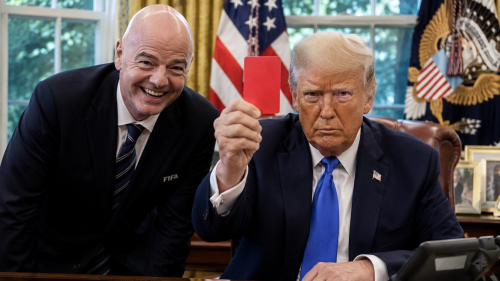
That controversy wasn't small: FIFA's scrapping of USA striker Folarin Balogun's suspension, after Trump's intervention, provoked what's being called the first major rebellion against Infantino, with German tactician Jürgen Klopp calling it madness that calls everything into question.
Then there's the pattern behind it. Infantino's decade in charge has increasingly been defined by political proximity to state power rather than the reform and transparency he promised when he first ran for the office in 2016.
In 2019, he reportedly stood before Vladimir Putin in the Kremlin, praised Russia's World Cup, and accepted an award from the Russian president, and evidence of him cultivating close personal ties with authoritarian heads of state, not just diplomatic courtesy.
Add in the FIFA Peace Prize handed to Trump and the awarding of Saudi Arabia's 2034 World Cup, and it's easy to see why senior figures in English football, including former FA chairman David Bernstein, have called for Infantino's resignation.
Germany has become one of the first major football federation to openly withhold backing for Infantino amid mounting criticism, yet none of this seems to matter where the votes count.
The Nigeria Football Federation Letter
Nowhere is small-federation loyalty clearer than in a recent letter from the Nigeria Football Federation (NFF). The letter didn't just nominate Infantino — it explicitly stated that the NFF exclusively supports Mr. Gianni Infantino for the position of FIFA President and, therefore, will not sign any other declaration of support in favor of any other candidate for this position.
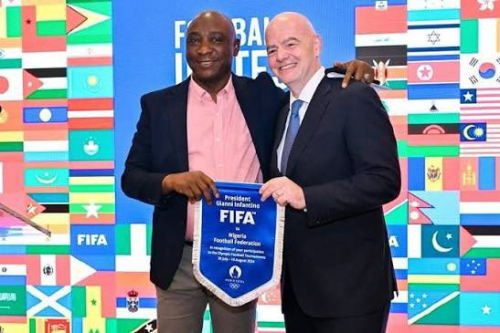
That single line matters. It's not just an endorsement, it's a lock. The letter was signed the very day Infantino announced his candidacy, and it emerged that FIFA staff had been actively lobbying, even sending template wording, to national association presidents to secure such declarations, despite this reportedly breaching FIFA's own Code of Ethics on political neutrality.
Why the Small Federations Stay Loyal
Why would smaller nations line up so eagerly, even as the football world grows louder in its criticism? The answer is short and simple: they follow the money.
The FIFA Forward program distributes over $1.5 million per cycle to each member federation, and presidents who control that flow effectively control how federations vote.
This many not be done by explicit vote-buying, but because federations whose priorities align with the incumbent simply keep backing him. In the 2027-2030 cycle alone, FIFA has pledged to distribute $2.7 billion to its members, an eight-fold increase from a decade ago.
For federations where football is the primary source of national sporting revenue, that money is more than just a bonus, it could mean their survival.
As England FA chief executive Mark Bullingham put it plainly: for many countries, FIFA funding represents 70-80% of their total football budget, compared to a fraction of a percent for England, and that imbalance explains everything.
CAF's 54 associations and AFC's 47 nations both pledged unanimous backing for Infantino ahead of the 2027 vote, joining CONMEBOL's 10, together accounting for 111 votes out of 211 before a single European or wealthy federation had said a word.
Aruba's own federation president, Egbert Lacle, summed up the emotional pitch that keeps small nations loyal: "Being small doesn't mean you cannot do it." Although this is a genuinely uplifting sentiment, it's also a sentiment FIFA has learned to monetise politically.
The Bigger Picture
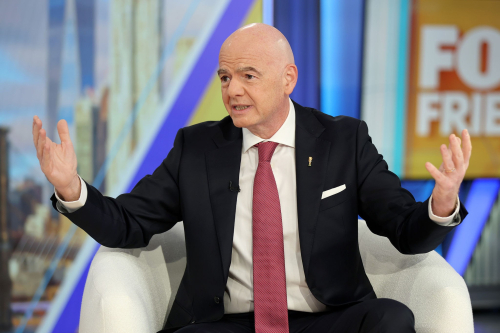
A recent German podcast investigation into FIFA's power structure captured this dynamic vividly, framing Gianni Infantino's continued grip on the presidency through the lens of federations like Aruba's — small in size, equal in vote, and structurally incentivised to stay close to whoever controls the purse strings.
It's a reminder that football's global governance isn't decided by the giants who fill stadiums and generate billions in broadcast revenue. It's decided by the many, courted quietly, one Forward Programme cheque at a time.
The irony is almost poetic, because the countries with the least football wealth hold the most power to decide who runs FIFA, and as long as this holds, Gianni Infantino's re-election in Rabat next March looks less like a genuine contest and more like a formality, regardless of how loudly the giants protest.
